
California MVR monitoring and driver records
California MVR monitoring, built on the DMV driver record and your own requester code.
The California motor vehicle record (MVR) is the DMV's driving history for one person, and the DMV releases it only to a business with its own requester code and an approved purpose. Expert, an approved service provider in the DMV's Commercial Requester Account program, pulls that record for you in seconds, re-checks a whole roster by batch or through the API, and writes every request to the log under your code.
Approved service providerDMV Commercial Requester Account program
30 dayspre-hire record window for commercial drivers under Vehicle Code 1808.1
Roster re-checksby batch or API, on the cadence your policy sets
Every pull loggedunder your requester code, ready for the DMV
Operated by the team behind
CarRegistration.com
Why businesses pull driver records through Expert
The DMV driver record, the DMV way, on your schedule.
Driving records are released under stricter rules than almost any other business data: a DMV-issued code, a stated purpose, a signed security statement for every user and a log of every pull. Expert is built around those rules, so the record arrives fast and the paperwork is already right.
01
Seconds, not a mail cycle
A paper driver record request takes the DMV roughly two weeks. Through Expert the same record is on screen while the applicant is still in the chair, so the hiring decision and the record arrive together.
02
Your requester code, your permissible use
The DMV issues the requester code to your business, for the purpose you stated. Expert attaches that code to your account, shows which report types it may receive, and writes each pull to the log the DMV can ask for at any time.
03
Monitoring that fits your policy
Pull a record at hire, then re-check the roster by batch as often as your policy requires: quarterly, at renewal, after an incident. Each re-check runs under your code and is logged.
One driver record, start to finish
From license number to driving record, in four moves.
1
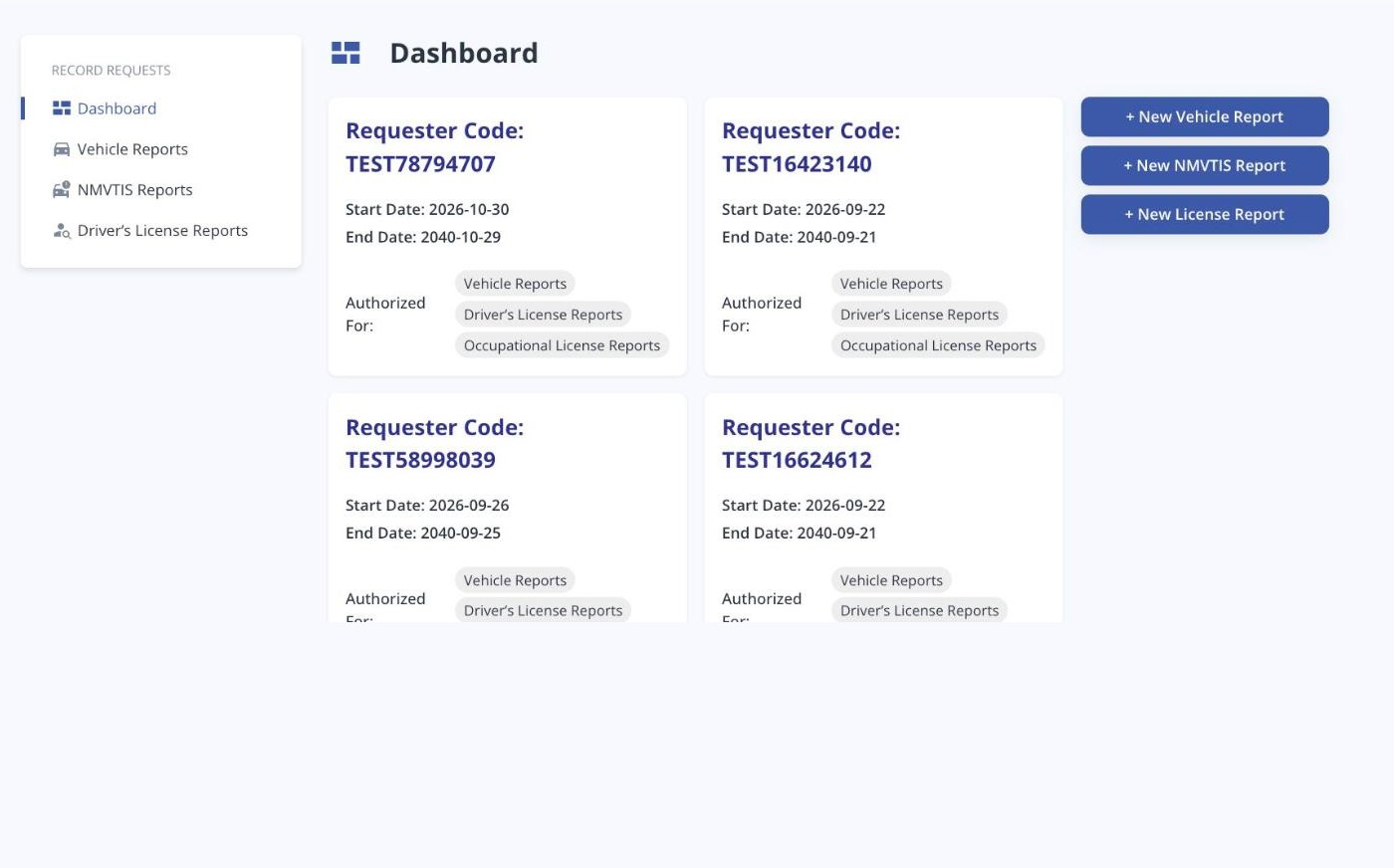
Your code, with driver's license reports on it
Your Expert account shows each DMV requester code with its dates and the report types the DMV put on it. For an MVR program, driver's license reports is the line that matters.
2
Start a license report
Enter the license number. The request goes to the DMV tagged with your code and purpose, and the record the DMV releases to that code comes back on the same screen.
3
Read the record
License status and class, endorsements and restrictions, reportable convictions, collisions, failures to appear and departmental actions, as the DMV reports them. A roster re-check runs the same way, by batch.
4
Logged for the DMV
Each pull is logged under the code that ran it, with date and user, so an audit request is a download, not a reconstruction.
Who runs California MVR checks
Built for the businesses that put drivers on the road.
The DMV releases driving records to businesses with a legitimate need to know who is behind the wheel. These are the ones running MVRs through Expert.
What a California MVR shows
- License status, class and expiration
- Endorsements and restrictions
- Reportable convictions and points
- Collisions the DMV has on record
- Failures to appear and failures to pay
- Suspensions, revocations and other departmental actions
The DMV reports only reportable items under Vehicle Code section 1808, each for a set number of years. The retention table is in the reference below.
Employers and fleets
Pull the pre-hire record Vehicle Code section 1808.1 requires for commercial drivers, issued less than 30 days before the hire date, and re-check the roster on your schedule. EPN enrollment stays with the DMV.
Insurers
Driving record at underwriting and renewal, license status on a claim. See DMV services for insurers.
Rideshare, delivery and gig platforms
Run the record on every driver you onboard, and again on your program's cadence, by batch or API.
Staffing and screening firms
Pull the California MVR for a candidate under your own requester code and approved purpose, logged.
Registration services and dealers
Driver's license, vehicle and NMVTIS reports from the portal that keys your DMV transactions.
Volunteer and nonprofit programs
A license check on anyone who drives for the program, under its own requester account.
Batch and API for a whole roster
A fleet does not check drivers one at a time. Expert gives a roster two more routes to the same DMV record, both tagged with your code and both logged.
- Batch: a spreadsheet of license numbers goes in, the driving records come back as a set in minutes
- API: your onboarding or fleet system calls Expert and the record lands in your own workflow
- Re-run the same roster quarterly, at renewal or after an incident; every run is logged
- Priced by the number of records you run in a month, training and the partner line included
Support from people who read DMV records for a living
The partner line has seen it before: a code not yet authorized for driver's license reports, a record that does not match the license in your hand, a departmental action nobody can decode. Behind the line, Expert's compliance team writes up what a requester account holder has to do each year and keeps it current in the knowledge base.
Why Expert
A driving record is only useful if you read it right. We read them all day.
CarRegistration.com, the largest registration service in California, has pulled and read DMV records for more than a decade on its way to millions of transactions and billions of dollars in DMV fees. The people on Expert's partner line are the people who did that work.
Car Registration Inc built Expert for its own volume and holds both DMV approvals the work needs: service provider under the Commercial Requester Account program for records, and First Line Service Provider under the Business Partner Automation program for registration and titling. One company, one portal, one line to call.
| DMV status | Service provider account under the Commercial Requester Account program (DMV program page), the account the DMV requires of any vendor requesting records for a business |
|---|---|
| Operator | Car Registration Inc, the company behind CarRegistration.com |
| Report types | California driver record (MVR), vehicle registration record (KSR), NMVTIS vehicle history |
| Ways to run a record | Keyed in the portal, uploaded as a roster for a batch run, or called through the API from your system; the result and the log entry are the same |
| Logging | Date, user and requester code written on every pull, downloadable for a DMV request |
| Support | Processors on the partner line, a compliance team behind them, training and the knowledge base included |
| Same portal | DMV registration and titling for registration services and dealers, who run driver records from their transaction screens |
30 dayspre-hire record window under Vehicle Code 1808.1(a)
10 yearsmost 2-point violations stay on the record
$2DMV fee per electronic driver record
1 lineto call, staffed by people who read these records
Getting started
Five steps to a driver record program the DMV will sign off on.
Nobody can hand you a driving record until the DMV has issued your business a requester code for a stated purpose. Expert's job is to get you to that code without a false start, then make the first pull and every re-check routine.
1You
Name the drivers and the reason
Employees who drive, insured drivers, platform drivers, candidates. Expert matches your reason to a permissible use under the DPPA and the Vehicle Code before anything is filed, and tells you whether written consent is part of your process.
2You
File with the DMV
The requester account application (INF 1106) and a security statement (INF 1128) signed by every person who will see a record, with the $50 fee for a code without residence addresses. Expert reviews the package before it goes in.
3DMV
The DMV decides
The DMV issues the requester code and lists the report types it covers. Driver's license reports are the authorization that matters for an MVR program.
4Expert
Code on, users on, roster loaded
Expert attaches the code to your account, creates a login for each INF 1128 signer, loads your roster for batch runs if you have one, and trains the people who will read the records.
5You
Pull, then re-check on your cadence
First record in seconds, then the roster by batch or API as often as your policy says. A business that already holds a code with another provider skips to step 4.
The DMV sets the account rules. The full requester account requirements table is on the vehicle registration records page, and the forms are on the DMV Commercial Requester Account page.
Reference
California motor vehicle records (MVR), explained.
The driving record itself, how long each item stays on it, who may pull it, where the Employer Pull Notice program fits, and what the DMV charges, each with its source.
- What a California MVR is
- What stays on the record
- Who may request one
- Employer Pull Notice
- Misuse penalties
- What it costs
What is a California motor vehicle record (MVR)?
A California motor vehicle record, also called a driver record or MVR, is the DMV's record of one driver: license status, class, expiration, endorsements and restrictions, reportable convictions, collisions, failures to appear and departmental actions such as suspensions and revocations. The DMV reports only reportable items on a current driver record, per Vehicle Code section 1808 and the DMV driver record request page.
An MVR describes the driver, not the vehicle. Ownership, lienholder and registration status live on the vehicle registration record (KSR), a separate report under a separate authorization.
How long do items stay on a California driver record?
Retention periods below are from the DMV driver record request page.
| Item | Reported for, per the DMV |
|---|---|
| Most 2-point violations | 10 years from the violation date |
| Other traffic convictions | 3 years from the violation date |
| Collisions | 3 years from the collision date; 10 years if law enforcement reported a commercial vehicle or hazardous materials indicator |
| Failure to appear, DUI offense | 10 years from the violation date |
| Other failures to appear and failures to pay | 5 years from the violation date |
| DUI-related actions | Generally 3 years after the proof termination, action termination or reinstatement date, whichever is earliest |
| Actions against certificates or endorsements | 1 to 12 years, depending on the reason |
Who can request a California MVR for another person?
Another person's California driving record is available only to a holder of a DMV requester code, issued under Vehicle Code section 1810.2 to a requester whose purpose relates to a legitimate business or commercial purpose, and cancellable the moment the information is used for anything else. The business applies for a Commercial Requester Account on the DMV's forms, and every person who will see a record signs an Information Security Statement (INF 1128) at authorization and again each year. The driver's residence address is confidential under section 1808.21; a code without address access, the usual case for an MVR program, carries a $50 fee and no bond. Since April 1, 2026, the account files and receives everything electronically under 13 CCR section 350.47.
Federal law adds its own list. The Driver's Privacy Protection Act, 18 U.S.C. 2721, permits disclosure to insurers, to a business verifying what an individual submitted to it, and to any requester holding the individual's written consent, the basis most employers use when screening drivers. A consumer who wants their own record goes to the DMV; Expert serves businesses only.
How does the Employer Pull Notice (EPN) program fit?
The Employer Pull Notice program is the DMV's own monitoring program under Vehicle Code section 1808.1. Per the DMV EPN program page, employers must enroll drivers who need a commercial Class A or Class B license, drivers who need a Class C endorsement for hazardous materials, passenger vehicles or tank vehicles, drivers for hire for a charter-party carrier, and drivers for a CPUC-licensed passenger stage corporation. The DMV sends the enrolled employer a driver record every year on the enrollment date and whenever a conviction, collision, failure to appear, suspension or revocation posts. The program runs electronically through the EPN online requester portal, Secure File Transfer or a DMV-authorized EPN agent (INF 2110).
Section 1808.1(a) also requires the prospective employer of one of these drivers to obtain a report of the driver's current public record before hiring, issued less than 30 days before the hire date, reviewed, signed and dated, and kept at the place of business until the first pull notice report arrives. That pre-hire report is a California MVR. Expert runs it under your requester code in seconds. EPN enrollment itself is with the DMV, and the employer stays responsible for compliance with section 1808.1 whether or not an agent is used. Expert covers the checks EPN does not: the pre-hire record, drivers outside the required classes, insurer and platform re-checks, and a full-roster batch whenever your policy calls for one.
What happens if DMV record information is misused?
Under Vehicle Code section 1808.46, obtaining DMV information by false representation, distributing restricted or confidential information, or using it for a purpose not authorized in the requester code application carries civil penalties of up to $100,000 payable to the DMV, and requester code privileges are suspended for up to 5 years or revoked. The federal Driver's Privacy Protection Act adds a civil action by the individual, with liquidated damages of $2,500 per violation under 18 U.S.C. 2724.
What does a California MVR cost?
The DMV charges $2 for each driver record delivered electronically, $5 for a standard request and $20 for a microfilmed copy, per its Commercial Requester Account page. Expert's service fee sits on top and is priced by how many records you run in a month; training and the partner line are part of it, not add-ons. The walkthrough ends with a quote.
Before you ask
California MVR monitoring, frequently asked questions
Does Expert sell California driver records to individuals?
No. Expert serves businesses holding a DMV requester code and a stated purpose, and runs each record under that code. A person who wants a copy of their own driving record orders it from the DMV.
Do I need my own requester code to run MVRs through Expert?
Yes. The code belongs to your business and your purpose; a service provider cannot lend you its own. Without one yet, you start at step 1 of the getting started section and Expert reviews the package before the DMV fee is paid.
What is MVR monitoring, and how does Expert do it?
MVR monitoring is re-checking a driver's record after the first pull so a new conviction, suspension or revocation is not missed. With Expert you pull the record at hire and re-run the roster by batch or through the API on the cadence your policy sets, each run logged under your requester code. Drivers the DMV requires in the Employer Pull Notice program are enrolled with the DMV; Expert covers the checks around that program.
Are residence addresses needed for employment screening?
Usually not. Most employers and insurers need license status, class, endorsements, convictions and actions. A code without residence address access carries the $50 filing fee and no bond; residence address access carries the $250 fee and a $50,000 bond under Vehicle Code section 1810.2.
How is a California MVR different from a CLUE report?
A California MVR is the DMV's driving record for one driver. A CLUE report is a claims history compiled by LexisNexis. Insurers use both; Expert provides the DMV record.
Can we run MVRs in batch or through an API?
Yes. A roster of license numbers comes back as a set of driving records in minutes, and an API lets your onboarding or fleet system request records directly. Both routes carry your requester code and land in the same log as a record keyed by hand.
We already process registrations on Expert. Is this a separate account?
No. A registration service or dealership that processes on Expert runs driver's license reports from its transaction screens, under the requester account it already holds. Nothing new to log into.
Next step
Tell us who you check and why. We take it from there.
Twenty minutes on a call: we match your reason to a permissible use, pull a sample driving record on screen, size batch or API for your roster, and list what the DMV will want. Then you decide.
Driver records sales(916) 407-3359
Emailsales@expertevr.com
Car Registration Inc operates Expert. Expert holds a service provider account in the California DMV Commercial Requester Account program and a First Line Service Provider contract in the Business Partner Automation program; both are program statuses, and the DMV endorses no provider. A driving record is released only to a DMV-issued requester code for the purpose the DMV accepted, under Vehicle Code section 1810.2 and the federal Driver's Privacy Protection Act. The DMV administers the Employer Pull Notice program under Vehicle Code section 1808.1. Fees, retention periods and timelines on this page come from DMV pages and change when the DMV changes them. Product screens show Expert's test environment and sample data.